Building a Movement for Mumia, 1986-1995

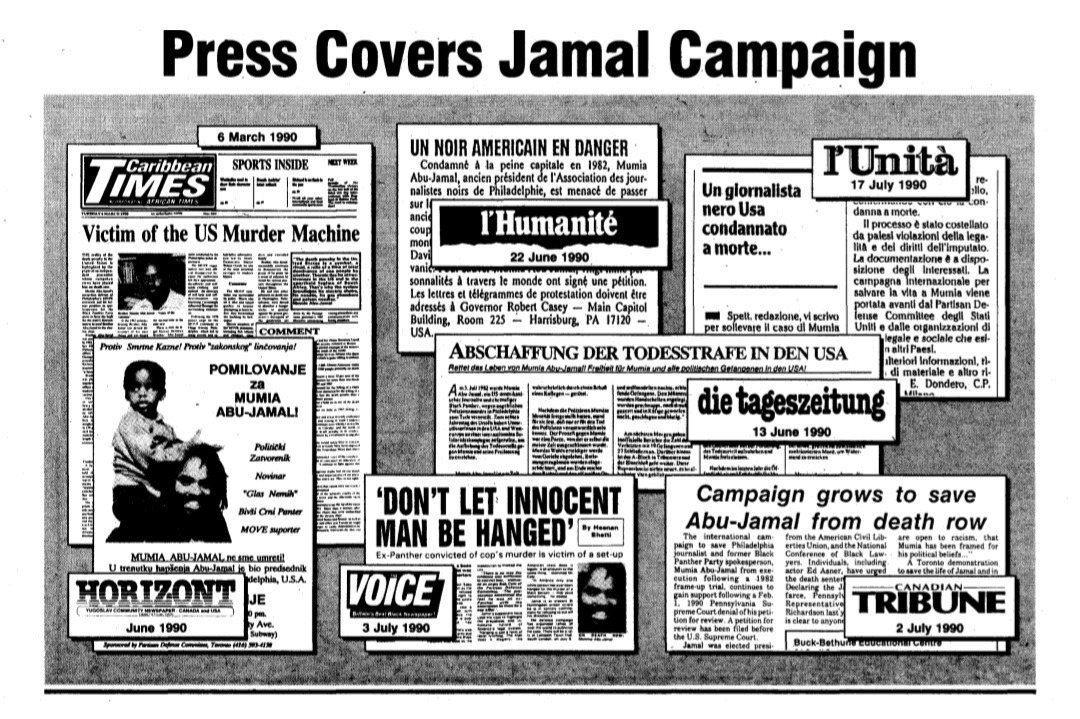
Outside of Philadelphia there was little knowledge of Mumia’s case in the early 1980s. Other than MOVE the only organization taking up his case was the Revolutionary Communist Party. The PDC first learned about Mumia in late 1986 through MOVE, whose members were among the first recipients of aid from our class-war prisoner stipend program. In 1988 the PDC launched a campaign for Mumia coupled with the fight to abolish the racist death penalty. A year later we extended it internationally.
We always understood that labor’s power is critical for successful class-struggle defense. We got support for Mumia’s cause from various union locals—AFSCME (public sector workers), CWA (communications workers), SEIU (service workers), ILA and ILWU longshore workers, the Amalgamated Transit Union, the United Auto Workers, as well as teachers and others. Our fraternal defense organizations internationally did the same. By the fall of 1990, support for Mumia encompassed hundreds of thousands of trade unionists—for example, the Metro Toronto Labour Council; the CGT, France’s largest labor federation, led historically by the Communist Party; the British National Union of Railwaymen; the Australian Firemen and Deckhands’ Union, as well as national journalist associations. This support included letters, resolutions, and petition signatures.
The first part of our international campaign culminated in united-front rallies in major cities around the world in June-July 1990. Not only did we bring together a wide range of organizations and individuals representing labor, civil rights, and civil liberties organizations, but also shared the platform with people who had been victimized by the state—former death row inmates and political prisoners.
In the course of building our united-front rallies, we assisted, in a non-sectarian way, the initial efforts of numerous other groups as well as individuals who became involved in the campaign for Mumia: Equal Justice, which was run by the Quixote Center, a liberal Catholic organization; AGIPA-Press (American Counter-Information Press) in Germany, which spread word of Mumia’s case throughout Europe; MRAP, which was a Communist Party-supported organization in France. The International Concerned Family and Friends of Mumia Abu-Jamal, initiated by the MOVE family, and headed up by Pam Africa, began its campaign in 1991.
We also fought to make Mumia known as a working journalist on death row so that he would not be nameless and faceless, to make it harder to execute him. Mumia began writing commentaries on a regular basis. Initially it was the PDC that typed up the commentaries, duplicated and mailed them, primarily to the black press, and campaigned for them to run Mumia’s columns regularly. We assisted Mumia with a 1991 article on life on death row printed in the Yale Law Journal and in getting the first national coverage of his case and commentaries, which appeared in the Nation.
This led to National Public Radio announcing in 1994 that it had agreed to run Mumia’s commentaries weekly on its program “All Things Considered.” Cowering under howls from the Fraternal Order of Police and Senatorial threats of cutting off funding, NPR threw Mumia under the bus. But much to the FOP’s chagrin, the NPR controversy put a national spotlight on Mumia’s case and the fight against racist legal lynchings. Following NPR’s betrayal, the Pacifica Radio News network, which had 60 stations, announced it would broadcast Mumia’s commentaries as part of its daily news program.
In June 1994, the PDC and the Committee to Save Mumia Abu-Jamal responded to NPR’s censorship by organizing a speakout at NYC’s Ethical Cultural Society, which featured a reading of Mumia’s commentaries, including the late actor and political activist Ossie Davis, who was co-chair of the Committee to Save Mumia.
By the beginning of 1995, Mumia’s cause was known on a worldwide scale among youth, trade unionists, and large segments of the liberal intelligentsia. Pennsylvania’s new governor was right-wing Republican Tom Ridge, who campaigned on a promise to churn out execution warrants to clear the state’s death row population. It was clear that Mumia’s fate was at a critical juncture. The PDC and our fraternal organizations initiated protests in the U.S., Berlin, Paris, Tokyo, and Sydney. The high point of the February 7 Berlin demonstration was a statement from the powerful IG Medien newspaper union, announcing that it had made Mumia an honorary union member.
In anticipation of an execution warrant organizational activity stepped up over the next few months.